
As an Amazon Associate I earn from qualifying purchases

There’s a little video that’s been making the social media rounds of late that will be of interest to readers of ClassicalEd Review. Filmed and posted on TikTok by a student1 at a “science and technology” charter school out east,2 it depicts a series of hapless high school peers of the filmmaker attempting on camera to read aloud a hand-written sentence3 presented to them on a 3x5 card:
She wore a silhouette of clothes that were extraordinary but somewhat gauche.
Now, let’s speak frankly: this sentence is clumsily adolescent, the author obviously trying to construct something “elevated” that he knows his classmates will struggle with. The phrase “silhouette of clothes” sort of delicately wafts across your brain like a translucent silken veil at first, but then you realize that it doesn’t paint a clear picture of anything: I know what a silhouette is, and I know what clothes are, but if I can see a silhouette, it is dark with a light source behind the subject, and if it is dark, I don’t think I can confidently say that the clothes are extraordinary, or gauche, or both, or extraordinarily gauche. And here’s another serious weakness in the sentence: the author sets up “extraordinary” and “gauche” as if they were clear antitheses/opposites, but that is hardly the case: something on the higher end of the gaucheness spectrum will likely also be extraordinary. I suspect that the writer meant something other than what he actually said here.
Were I the student’s teacher, I would work with him to recraft this sentence: tell me in other words what you are trying to say. What do you mean by “silhouette”? That’s a very specific word that means an outline of something. Are you just trying to find a creative way to say “outfit”? If so, “silhouette of clothes” won’t quite work—it’s just, well, it’s not a thing you can say; those words just don’t work together in English. It’s like saying “admirable perspiration” or “investigation on epistemological basketball.”4 What are some elevated synonyms for “clothes” or “outfit”? -- “Extraordinary”: it sounds as if you want to say something positive or complimentary about the outfit in question, while noting that it is also tasteless, vulgar, gauche. Is that the case? If so, come up with a more specific positive adjective suitable to the scene you have in mind. “Extraordinary” is bland, cheap, overused to the point of meaninglessness. Like “nice” or “interesting”. Is the outfit “eye-catching”? “Unforgettable?” “Striking?” Since it’s a she who is wearing the ensemble (ooh! That’s a good word.), are you imagining something that a man would find alluring or enchanting? Find a way to say that, because “extraordinary” just isn’t strong enough.
But setting aside the fact that this sentence is amateurish and unclear, it is short, contains no extended modifiers or subordinate clauses, and has some high school level words in it, and at least one college-bound word.5 It would not be unreasonable to expect that upper-grade high school students at a prestigious school like Science Charter Prep Career Academy Prep School would at least be able to pronounce it out loud.
Of course, the video would not have gone viral if the students featured in it had done so. It’s a catastrophe, with students misreading “were” for “wore”, mangling “silhouette”, naturally having no idea what to do with the college word “gauche”, and even making a mess of “extraordinary”, in the mouth of one young man, “exter…gurrnery, whatever, bro!” Not one student filmed is able to make it through the sentence without a major pause or a nervous interjection; one student reads two words and then gives up.
A follow-up video posted by the same TikTok user features a slightly easier sentence: The colonel asked the choir to accommodate the general’s schedule. Aside from the expected stumbles upon the correct pronunciation of “colonel”, this time most of the students in the video are able to make it through from start to finish. Where it then gets interesting is when the young man with the camera asks his peers to explain what the sentence means.
One is notable because all he can do is reorder the given words and repeat them back to the camera. “It’s like, there’s a choir, and the colonel asks them to accommodate the general’s schedule,” he says. “But in your own words?” asks my nominee for the inaugural ClassicalEd Review Excellence in Student Journalism award. “I don’t know, bro, like, he asks them if they will accommodate the general’s schedule or something.” I cannot count the number of times I encountered the same phenomenon in my own high school teaching years, and assuming that the students know the meanings of the individual words in a sentence, they can be easily trained to restate with fluency: Ok, what does “accommodate” mean? Who is more important—a colonel or a general? What does it mean for the choir to accommodate the general’s schedule—and what would the opposite mean, i.e. for the general to accommodate the choir’s schedule? Ok, now explain what this sentence means in your own words; tell me the story of what’s going on here. (The key word is “trained”—if the teacher is to help the students who struggle with this kind of thinking, he must repeat this little exercise over and over again in the classroom. “Training” means rigor and repetition—do it on the spot and unexpectedly in the middle of class, do it while meeting with a student one-on-one about a writing assignment, do it in the middle of the reading of a paragraph for closer analysis. Just keep doing it over and over, and do not for one second balk because you are afraid of making struggling students feel uncomfortable. Do it with spirit and flair and without apology. All the best teachers I ever had, men and women alike, did this kind of training and intellectual disciplining of their students on a daily basis. Yes, sometimes it made us “feel bad”. Then next time, when we did it better, we felt better. It would be a better world if more teachers of all subjects at all grade levels acted more like ursine Romanian Olympic gymnastics coaches6 and less like volunteer pre-K church childcare staff.)
Two students, when asked to explain the sentence, said more or less the same thing: that it simply meant the colonel was asking the choir to sing for the general. I suppose this makes a sort of sense: there’s a choir, and choirs sing, so if someone is asking a choir to do something, it’s probably singing. Makes sense. This REALLY got my attention, for it reminded me of the way in which multiple generations of Americans have been (mis)taught to read since the 1970s, and of a disastrous method once as unassailably THE way to teach reading in American schools as bloodletting was the standard treatment for a fever in pre-modern medicine: the Three Cues method. In the last decade it has finally begun to be disestablished, but its shadow looms long.
Pioneered by an arch-educationist named Ken Goodman7 in a “groundbreaking” 1967 paper, Three Cues proceeds from the entirely-unconfirmed theory8 that phonetics—the relationship of letters to sounds in English—is not really all that important to making sense of words, and that context and syntax actually do most of the work for us; teaching phonics, which is real hard, can thus be dispensed with in the elementary school classroom, and we can get down to a much more efficient and joy-filled way of unlocking the treasures of written language for children:
THINK OF SOME WORD THAT STARTS WITH THE SAME FIRST LETTER THAT YOU SEE HERE. IT’S PROBABLY CLOSE ENOUGH.
OR GUESS A WORD THAT MIGHT MAKE SENSE, ESPECIALLY IF THERE’S A PICTURE TO HELP YOU GUESS ONE. ISN’T THIS FUN?
OR JUST SKIP IT. ALSO FUN!
I am not making this up, though if I were making it up, you can be certain I’d make the “teacher resources” in Comic Sans font:

Of course, we run into trouble when a couple of things happen. First of all, at some point, the pictures start to disappear, though the educationists will surely find a way to postpone their departure as long as possible, perhaps even indefinitely if publishers can be convinced there’s big money to be made in producing illustrated books for the high school market.
But even long before any potential illustration-dearth, we can have problems. For example, an “emerging reader” might be presented with this:
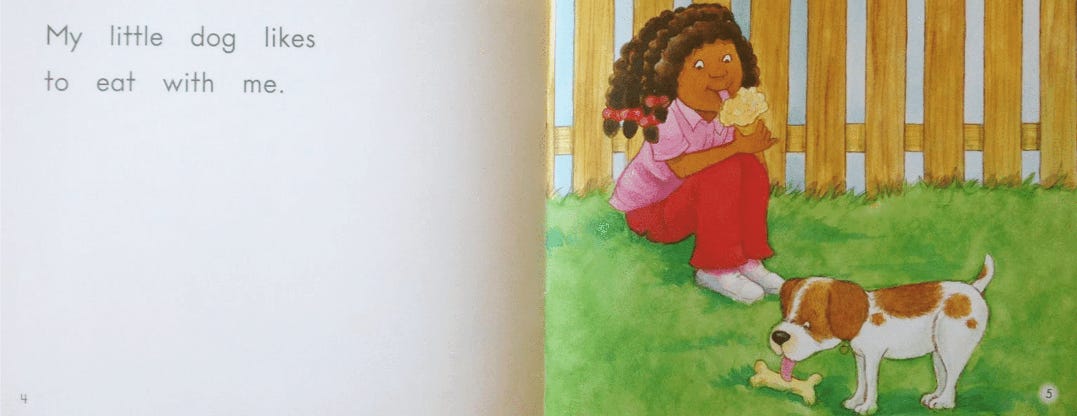
If he uses the “strategies” he’s been taught in the Three Cues classroom, he would be perfectly justified in reading this as My dog likes to lick his bone. I mean, it makes sense—just look at the picture! That’s what the dog is doing. If the text said anything about eating, the picture would show the dog wolfing down Purina Puppy Chow9 out of his doggie bowl. Everyone knows that dogs gnaw on bones for oral-dental-masticular stimulation, not for nutritional value, except maybe educationists. There’s a thought: gnawing on an educationist would probably have some nutritional value.10
Speaking of educationists whose work we think should be fed to the dogs, it turns out that Darth Dyslexus doesn’t actually see this misreading as a problem. In a 2019 interview featured in an article which I have shamelessly pillaged, when asked to comment on the decades of hard cognitive science that have totally debunked the Three Cues method, here was the 91-year-old Goodman’s response:
“Word recognition is a preoccupation,” he said. “I don’t teach word recognition. I teach people to make sense of language. And learning the words is incidental to that.”
He brought up the example of a child who comes to the word “horse” and says “pony” instead. His argument is that a child will still understand the meaning of the story because horse and pony are the same concept.
I pressed him on this. First of all, a pony isn’t the same thing as a horse. Second, don’t you want to make sure that when a child is learning to read, he understands that /p/ /o/ /n/ /y/ says “pony”? And different letters say “horse”?
He dismissed my question.
“The purpose is not to learn words,” he said. “The purpose is to make sense.”
This is truly extraordinary: “sense” is to be constructed apart from the real, existent text; it should probably be somewhat based upon the letters on the page, but it doesn’t matter all that much, as long as you make it “make sense” to you, the reader/meaning-fabricator. Who says that that Sith lords deal in absolutes? Poppycock. This is about as flexible as you can get: “Maybe, Luke. I could have killed your father. Or maybe I am your father. Or maybe I just asked your father to accommodate the Emperor’s schedule. What makes sense to you?”
One notes how consistent this slipshod, pop-Heraclitus, all-is-flux thinking is with Ken Goodman’s claim that a horse and pony “are the same concept,” hippology being a subject he is every bit as qualified to pronounce upon as the formation of intellects. Close enough. I wonder what other reality-hostile, distinction-denying assertions he might own up to?
Goodman rejected the idea that you can make a distinction between skilled readers and unskilled readers; he doesn’t like the value judgment that implies.
What a surprise. There’s no difference between a horse and pony, between eating food and licking a bone, between any two words that start with the same letter, any two narratives that are internally coherent, i.e. “make sense”, for example the Ptolemaic and Copernican systems, or Islam and Judaism—and no difference between “skilled” and “unskilled” readers. There’s probably no such thing as reading, either. There’s just sense-making, and that can happen just as well without a text as with one. There’s probably no such thing as “text,” either, so let’s blow up the word “literacy” and start applying it to all kinds of fun things that the kids are already really, really good at, like “consumer literacy”, “graphic literacy”, “social media literacy”, “brand literacy”, “meme literacy.” Come to think of it, what are we doing still talking about “sense” like it means something? “Sense” is whatever makes sense to the person making it make sense, and that’s everybody and everything. This is awesome. First, we get the summers off, and now, the school year just got a lot less demanding.
The kids in the TikTok video aren’t the victims of COVID and school closures, or brain-dead illiterate social media addicts whose spirits will torment Mark Zuckerberg in hell forever, or the zombie spawn of the iPhone: they are Ken Goodman’s kids. Luke—I am your father.
In his “part 2” video of his classmates struggling to read and explain a sentence, TikToker @whatthevek claimed, although this has not been independently verified by any sources, that he was now under disciplinary investigation at Career Science Prep Success Academy Math School for violating phone and social media use policy. He may well have broken their rules. Unfortunately, any sanction more severe than a slap on the wrist will give the impression that the school is simply retaliating against a student who blew the whistle on the abject failures of year upon year of schooling in South Philly. I mean, what the vek?

Andrew Ellison has been a leader in the classical liberal education movement since 1997, having served as a high school teacher, headmaster, and charter school administrator for 26 years in two states before moving into higher education. He is a Senior Writer for Cana Academy and posts regularly about classical education and other topics on LinkedIn. Ellison is currently Vice President of Enrollment Management at the University of Dallas. He writes from Irving, Texas.
A TikTok user known as @whatthevek, whom some sources identify as one Menvekeh Kosia, a senior student.
Sources indicate that the name of the school is “Preparatory Charter School of Mathematics, Science, Technology, and Careers” in South Philadelphia, apparently known as “Prep Charter” for short. You could reverse the terms (“Charter Prep”) and the flavor would be pretty much the same, which is a fairly reliable indicator of emptiness. Furthermore, the name “Prep Charter” suggests a somewhat superficial grasp of the meaning of educationy words, like calling something a “Learning School”, or, in the case of an actual district-run magnet school I once drove past in a major urban center in the desert southwest, an “Education Academy”. Ah, yes—an “education academy”. Good to specify. Don’t want to confuse it with any of those other “academies”.
Not even in cursive.
I am thinking here of a specific trend I have noted in classical schools of high aspirations which require of their graduates a senior thesis. A survey of the thesis titles for any given year, proudly published by the school in a newsletter or in a senior commencement program, invariably features a few thesis titles that, well, just aren’t quite English: “An Investigation on Justice,” or “A Refutation of Raskolnikov Based Off Father Zossima’s Teaching”. Based off—an ill phrase, a vile phrase. Quite gauche.
“Gauche”. I confess to never having heard this word until I got to college, used once in casual conversation by a freshman dorm floormate named Pete. We had a hilarious running joke on the floor about an imaginary self-storage facility called Pete Sass Storage—“Got a bunch of useless stuff? Put it in Pete Sass! Storage, that is!” and used to call him Pete Sass. Deep down inside, I know he loved the attention, in spite of the sullenness and occasional tears.
I think here of the great Béla Károlyi (1942-2024), who, as my many, many Magyar readers will be quick to point out, and maybe just a little bit too touchily so, was of ethnic Hungarian stock, politically a Romanian citizen because of the dismembering of the Austro-Hungarian Empire by the Treaty of Trianon (or as you all probably know it, the Trianoni békeszerződés) in 1920, placing millions of ethnic Hungarians under the intolerable foreign yoke of Serbs, Croats, Slovaks, and, of course, Romanians. It is not an entirely unrespectable opinion amongst contemporary Hungarian nationalists that the boundaries of the old kingdom should be restored, which would place millions of Serbs, Croats, Slovaks, and Romanians under Magyar rule, a manifestly more just state of affairs than the situation post-Trianon.
Known as “Darth Dyslexus” to his foes.
Standard educationist “research” method. 1. Make something up that is kinda cool. 2. Test it in your own mind to see if it “makes sense”. 3. Propagate it.
Which the more sardonic older dogs sometimes jokingly refer to as “Soylent Brown” and tell sinister tales of to frighten the puppies.
This is an admittedly cheap shot.