
When the Orange’s Face Flies Off
Opera Orange and the Lie of “Developmental Appropriatism" in Education
As a Midwestern non-denominational Christian child of the Carter-Reagan years in America, the central pillars of my early aesthetic and imaginative formation were a) Sunday school, for Biblical literacy and music; b) regular trips to the public library, carefully curated by my mother; and c) PBS television channel 341 in South Bend, Indiana. This was all back in the late 1970s, when the general cultural consensus amongst the decent social classes was that what mattered in a child’s upbringing was the content of television programming, not extensive exposure to the medium itself. Thus, unlimited hours of National Geographic programming, 3-2-1 Contact!, and Sesame Street couldn’t be anything but an educational force for good in the life of the young person, whereas one hour of Dallas or The Smurfs2 was thought to be a danger to the soul.
It seems quaint, but after all, this was a much simpler and more innocent time, when there were still plenty of cars on the road that were not equipped with the expensive option of seat belts, when cigarette advertising was ubiquitous on television and billboards, when red M&Ms3 were colored with carcinogenic dyes, and when no one had thought to put the DO NOT EAT warning label on the lethal little packs of silica gel that came with a new pair of shoes.4 We really made it by the skin of our teeth.
It was to Sesame Street that I owed my first, unforgettable exposure to Bizet’s Carmen. I speak, of course, of the Opera Orange vignette.
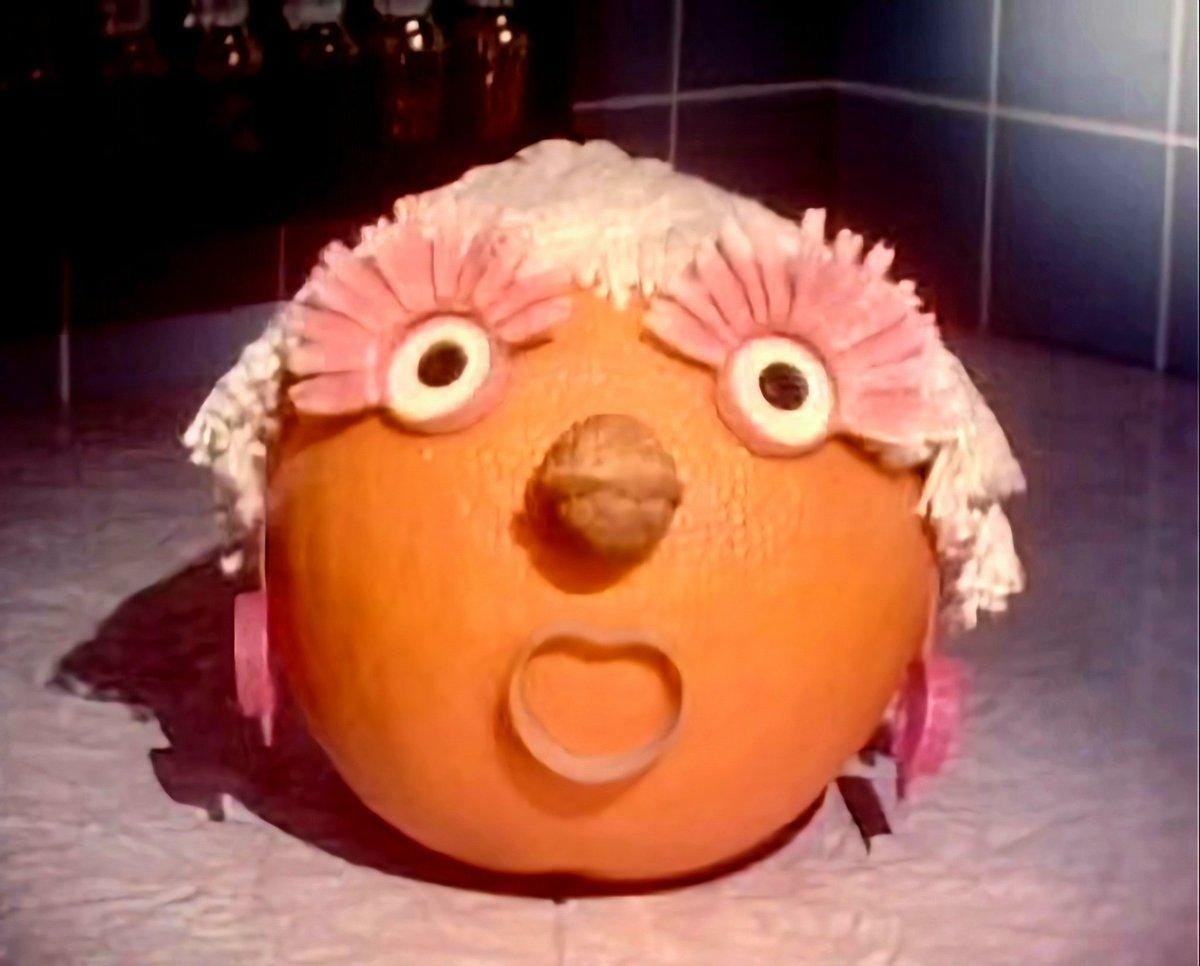
The scene: a dimly-lit kitchen. Through the magic of stop-motion photography, an orange hops out of a fruit bowl and begins its self-propelled hop-and-roll across the countertop. A weird Moog synthesizer soundtrack accompanies, reminiscent of Walter/Wendy Carlos’s5 electronic arrangements of Beethoven for the disturbing music to Kubrick’s A Clockwork Orange. As the orange goes forth, various commonplace items in the kitchen marshal themselves for the artistic collaboration about to occur and leap up to build a face: some coins and legumes form the eyes; a mesh bag of walnuts loosens itself and contributes a nose; the rubber band which had secured the nut sack inchworms itself over to the anthropomorphizing citrus and joins the ensemble as a mouth; a vase of flowers contributes a pair of glamorous eyelashes to the now-complete feminine countenance.
The orange begins to warm up her voice. She is a mezzo, but we can already hear that she is perhaps more soulful than skilled in the general singing area. The soundtrack develops, and the modestly attentive ear can now pick out major-key motifs from Carmen. A small kitchen mop hops atop the fruit and leaves a diva’s coiffure, and as a finishing touch, a pair of glass bottles pop their tops, which roll over and become earrings. She is ready.
The kitchen lights dim. A spotlight shines on our prima donna, and we hear the modal strains of an orchestra tuning up. A moment of silence, and then the fat synth-bass begins the unmistakable, steady D-minor ostinato that introduces Carmen’s “Habanera” aria, “Love is a rebellious bird.” Her voice bursts into life like the striking of a match:
L’amour est un oiseau rebelle,
Que nul ne peut apprivoiser,
Et c’est bien en vain qu’on l’appelle,
S’il lui convient de refuser.
Bizet’s music is so strong that it makes us forget we are watching a ridiculous animated fruit in a silly stop-motion puppetry. As a child experiencing it, I felt, albeit inarticulately, that Nietzsche’s sentiments about Carmen were my own: this music was “…perfect. It approaches lightly, supply, politely. It is amiable; it does not sweat.”6
She comes to the refrain:
L’amour—
L’amour—
L’amouuuuuurrrrrrr—
But her voice breaks. The music stops. She tries again, but loses it once more on the high C#. Undaunted, she goes for it one last time, givn a everythin’ she’s got,7 screeching a spectacularly unsuccessful
L’AAAAAAMOUUUUUUUUURRRRRRRRRRRRR!!!!!!!!!
And then her face flies off. >BOING<, in the description of the YouTube auto-generated subtitles. The beans, walnut, rubber band, and whole shebang rocket into the air and out of sight, a shocking and ghastly sight for the young viewer. But the true professional always recovers, and the Opera Orange shows us how it’s done: the parts of her face fall back into place, she finishes the aria as if nothing had happened, and audience roars its approval as her rubber-band mouth smiles and she bats her glorious flower-eyes at us.
(Sidebar: I would not mind living in a world in which, when musicians made huge mistakes, their faces would fly off. This would be especially helpful to the director of a large ensemble in rehearsals, enabling him to zero in on errant members and correct problems before the performance. Imagine the entire tenor section in a choir blowing a passage and all of their faces flying off: perhaps such a physiological consequence to a blunder would reinforce the importance of knowing your stuff. I think here of what Socrates says in the Gorgias about how, if we could see ugliness and ruin of the soul with our eyes as readily as we can see physical corruption, we would flee from evil like the poison that it is. Pretty much the same impact could be achieved by your face flying off.)
A charming little creative vignette, the Opera Orange. One of many such charming little creative vignettes from classic Sesame Street, like the bit about how saxophones are made, the little orange8 ball rolling along a roller-coaster-cum-Rube Goldberg track, the baker falling down the stairs with his cakes. Fun little program segments lasting a few minutes, and then the next fun little segment begins.
I’m sure somewhere some child psychologist or other propagated the prescription that this is what children’s television should consist of—brief, intensely interesting, thematically independent vignettes unconnected to what came before or after them, because the child’s mind is incapable of sustained attention. Juvenile consciousness is a Heraclitan flux of images and impressions which rapidly shift from one object of concentration to another, and therefore, kids’ TV ought to be structured this way. This is what educationists have long called “developmentally appropriate inputs.”
It is of course a confounded and preposterous and pernicious error of the worst kind, the fatuous derivation of a bogus “ought” from a rudimentarily scientific and descriptive “is”. It is an incomplete syllogism, in which one of the premises is hidden from the reasoners themselves:
P1: The child’s consciousness is naturally fragmented and cannot concentrate.
(P2: An unexamined assumption of some sort.)
Conclusion: Children’s television should be fragmented and not require concentration.
There is quite a bit of thinking that is missing where a second premise needs to be. For instance: if it is true that the childish mind is fragmented and cannot concentrate, is this a good state of affairs? If it is neither “good” nor “bad” but simply “natural”, how does it come about that the powers of concentration and integration arise? Is there something salutary about these powers? Is there anything that can be done to hasten their development? Should anything be done to hasten it? Can any television programming do this? If so, how, and what kind of programming? Is there another kind of programming that would retard the development of the mental faculties of concentration and integration? What would that look like? What psychological impact does television programming itself, no matter what the structure or content, have upon the child? Should children watch any television at all?
In light of this kind of basic questioning, the pediatric psychological purveyors of “developmental appropriatism” in broadcasting and education are primitives, unreflective cavemen in lab coats. They are quacks arguing that because smoking cigarettes induces a feeling of relaxation, it is conducive of good health, or that because the aged Emperor Augustus is suffering from a fever, he should be essentially poached alive in hot baths to bring about an equilibrium of his humors.
Few “ideas” have done as much harm in modern soul-shaping than this, that what is best for the fragmented and flighty child-mind is a steady diet of more fragmentation and flightiness. That what we feed the child via culture and schooling should be what is SIMILAR to the child, rather than what will serve to shape the child into something better than what it is naturally. That because the child naturally desires the spiritual equivalent of brightly-colored soda and sickly-sweet candy,9 we ought to gratify these wants.
The cumulative millennia of transcultural educational wisdom in C.S. Lewis’s Tao plainly says the opposite: that like will simply beget more like, that when human intention and agency is applied to Nature, the results can be super-naturally bountiful, that what is “developmentally appropriate” is what leads the child to growth, not what leaves them in a state of stupefied contentment.
The Tao preaches this consistently. It screams it at us, and when we don’t listen, it keeps on screaming until its face flies off.
>BOING<

Andrew Ellison has been a leader in the classical liberal education movement since 1997, having served as a high school teacher, headmaster, and charter school administrator for 26 years in two states before moving into higher education. He is a Senior Writer for Cana Academy and posts regularly about classical education and other topics on LinkedIn. Ellison is currently Vice President of Enrollment Management at the University of Dallas. He writes from Irving, Texas.
WNIT
Also common knowledge amongst Bible-believing Christians of the decent social classes: that The Smurfs was demonic, a propaganda-delivery mechanism for sorcery, black magic(k), and other nefarious Belgian influences.
The “silent killers”.
Keds and Zips. Whatever happened to Zips?
Trans 50 years before it was cool.
Der Fall Wagner 1
Captain
Orange spherical objects: a Leitmotiv of sorts in the Sesame Street corpus, it would seem.
I recall a thing not too long ago when certain makes of Christmas candy imported from south of the Rio Grande were found to contain trace amounts of lead. Nothing like a little deafness, hair loss, and imbecility in your stocking.